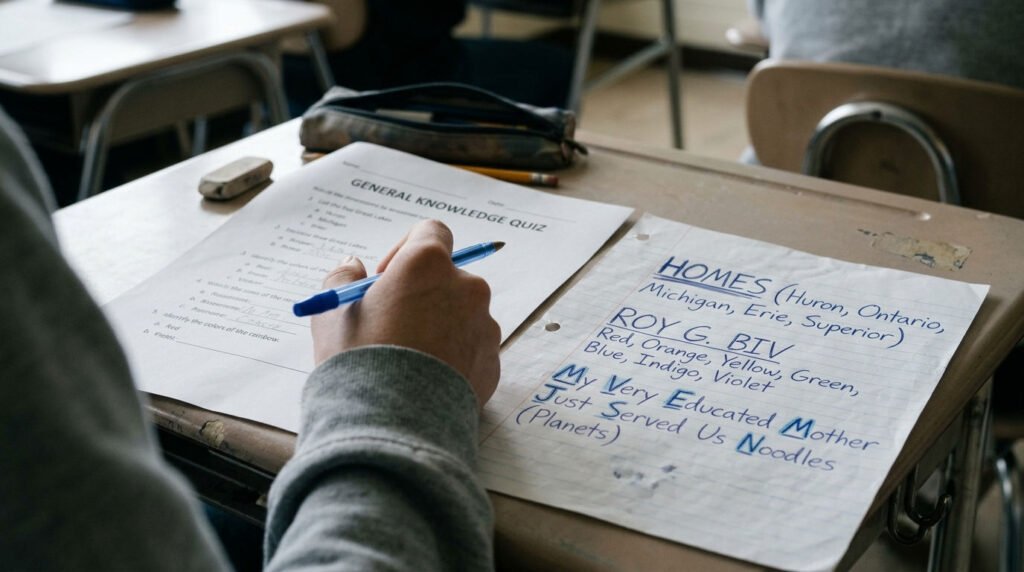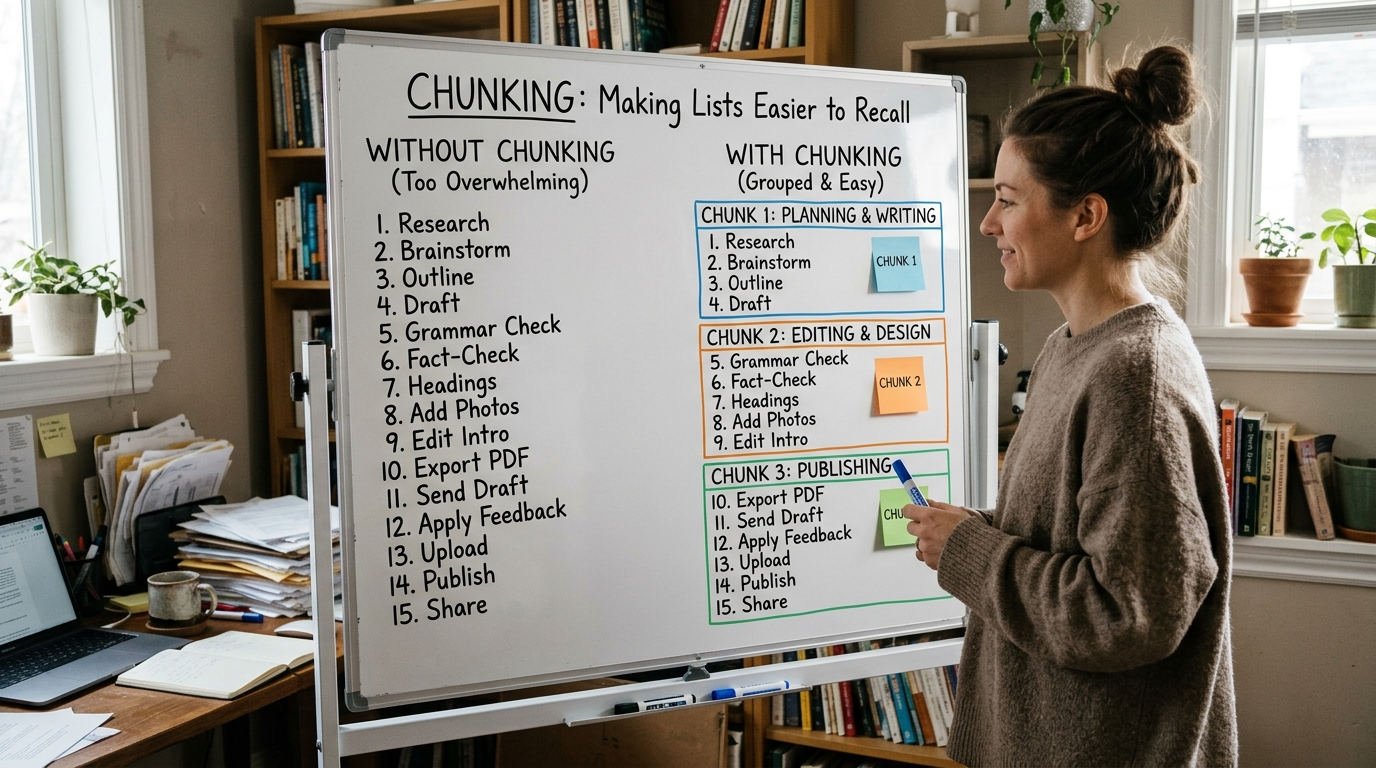
Chunking helps a long set of details feel more manageable by organizing them into meaningful groups. The groups should reflect the subject, not arbitrary pieces of text.
Find a natural organizing rule
Group vocabulary by meaning, process steps by phase, or dates by historical period. Meaningful chunks provide clues about what belongs together.
Suppose you have a list of eight laboratory items to remember. Instead of treating every name as an unrelated object, group measuring tools, containers, and safety equipment. These categories help reconstruct the list from meaning. Check that your grouping reflects genuine functions, because an arbitrary division by position may be easy to memorize but offer little help when a quiz changes the order.
Use categories before initials
A list of eight laboratory tools may become “measuring,” “heating,” and “safety” groups. Those categories give structure before you attempt memorization.
A geography chapter might list several types of landforms. Creating separate groups for erosion, deposition, and tectonic activity can give the vocabulary a conceptual map. First understand why each example belongs in its group; then practise recalling the members. A meaningful category label is a retrieval cue and a small explanation at the same time.
Make chunks small enough to retrieve
If a group becomes a paragraph, divide it again. The goal is to reduce the number of separate pieces you must hold in mind at one time.
If a chunk contains seven unfamiliar terms, it may be almost as difficult as the original list. Divide it into smaller groups or add a useful intermediate label. The ideal size varies with complexity and familiarity, so do not force a fixed number of items into each group. Test whether you can retrieve all members without silently glancing back at the source.
Keep sequence information intact
For an ordered procedure, organize steps into phases but preserve the order within each phase. Chunking should not erase relationships that the quiz tests.
A cooking procedure may be chunked into preparation, heating, and finishing. However, the exact order of steps within those phases may matter. Write the sequence separately and verify that chunking has not encouraged you to swap a prerequisite with its result. For timed sequence questions, knowing both the phase and its internal order is more useful than recalling only three headings.
Add a cue for each group
A heading, brief image, or simple keyword can help you reconstruct the contents. The cue should be easy to distinguish from the others.
An effective cue for a group might be “measurement” for four tools or “inputs” for the resources entering a process. The cue should make the group’s contents predictable. Avoid headings so broad that they could describe almost anything. If the label “important facts” is all you can think of, look for a more specific relationship that the subject material already contains.
Reassemble the whole list without looking
Recall one chunk at a time, then connect them in the original order. Test whether an item disappears when it sits between two groups.
After studying three chunks, cover the page and reconstruct them in order. Do not stop after remembering the group titles. List every item and explain why it belongs there. If the middle group is frequently incomplete, revise that particular category and its members. A full recall attempt reveals whether the organization is helping or simply making the notes look tidy.
Avoid hiding uncertainty inside a group
Remembering the group name is not the same as remembering every member. Check the individual items and their meanings against an answer key.
Chunking can conceal weak knowledge when you remember “causes” as a heading but cannot name or explain the causes beneath it. During practice, ask one question about a category and another about an individual item. The two tests reveal different levels of understanding. If a group repeatedly fails, add examples that distinguish its members rather than multiplying headings.
Apply chunking beyond memorized lists
A maths solution can be grouped into understand, calculate, and verify phases. The grouping supports both recall and a clearer method of working.
A long mathematical solution can also be viewed in phases: understand the problem, choose a formula, calculate, and verify. That organization can reduce the chance of forgetting a procedural check. It does not replace the algebra inside each phase. Practise with a fresh problem and explain transitions between phases so the structure remains useful beyond one memorized example.
Try it: group ten items into meaningful chunks
Turn a list of twelve biology terms into three meaningful groups based on functions or structures.
Name each group, hide the list, and recover both the groups and the individual terms.
Test the method by moving one term to a different group and explaining why that change is right or wrong.