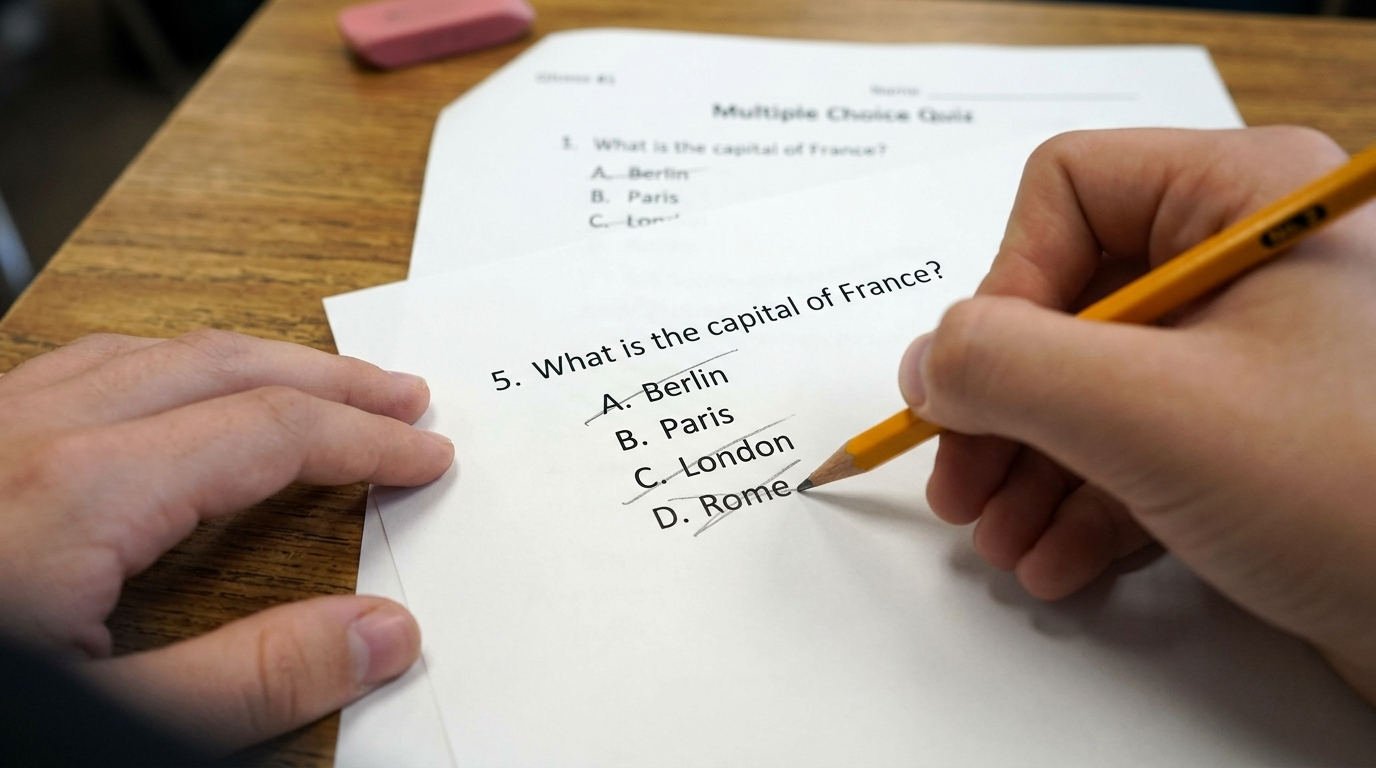
A careful reading can save you from answering a question you were never asked. The aim is not to move painfully slowly; it is to notice the small pieces of wording that determine what a correct response must contain.
Find the task before the topic
In a history question, “compare” asks for relationships, while “identify” asks for a specific fact. Locate the command word before searching your memory. A well-known topic can still produce a wrong answer when the requested operation is missed.
In a literature quiz, “describe the character” and “explain the character's decision” may concern the same scene, but the second requires a reason. Label the task before recalling the passage. If a question contains two commands, such as “identify and explain,” plan room for both parts. This is especially useful when the prompt looks familiar from homework yet asks for a different response.
Circle limits and qualifying words
Words such as “usually,” “only,” “during,” and “most likely” narrow a claim. Read them as part of the evidence, not decoration. “Which process occurs first?” is different from “Which process occurs fastest?” even when the answer choices are identical.
A qualifier can turn a correct general statement into the wrong answer for one specific item. Imagine a question asking which material is the best insulator among four listed choices. The selection must come from that list; a material you know is better but is not offered cannot be the marked choice. Practise reading conditions as boundaries on the problem, not as optional background.
Separate background from the actual question
Longer science or reading-comprehension items often open with a story. Identify the final sentence that asks for a response, then decide which details in the stem support it. Keep relevant numbers, definitions, and conditions; leave unrelated narrative aside.
A long word problem about a school trip may include prices, dates, and distances, but ask only for the average cost per pupil. Separate the figures used in that calculation from details included to make the situation realistic. Before beginning arithmetic, write “required: average cost” and circle the necessary numbers. If the question later asks for a different quantity, rebuild your selection of details.
Predict the shape of a valid answer
Before looking at choices, ask whether the answer should be a date, explanation, calculation, example, or exception. This preview reduces the chance of choosing an attractive option that belongs to the topic but not to the question.
For a geography item asking for the year of an event, an option naming a place can be ignored regardless of how relevant it is historically. A preliminary prediction can be modest: “I need a year in the correct period.” This protects you from the misleading feeling that a familiar-looking choice must be right. After selecting an answer, verify that its kind matches what you predicted.
Test the grammar of every option
In a sentence-completion item, the option must fit both meaning and grammar. In a comparison question, it must address both objects. Avoid judging a response on one familiar word when the rest contradicts the prompt.
Consider a blank reading question: “The pupils ___ their projects yesterday.” A technically interesting verb may not fit the tense. The grammatical frame points toward a past-tense form, while the sentence's meaning determines which verb belongs there. Use both checks; grammar alone may leave several possible choices. The strongest answer is coherent as a complete sentence and accurate for the topic.
Slow down at negative phrasing
“Which is NOT an example?” reverses the selection rule. Rephrase it as “find the exception” and keep that instruction visible. Negatives are particularly easy to overlook when you skim several questions in succession.
A science question that asks which statement is not supported by an experiment requires the exception, not the most familiar finding. Imagine three options that repeat measured observations and one that makes a claim about a variable never tested. To answer, identify the unsupported inference and keep the negative instruction in mind. Underlining just one word can prevent an otherwise knowledgeable mistake.
Use a two-read checkpoint under time pressure
Read once for meaning and a second time for the instruction, quantities, and exceptions. This can take seconds rather than minutes. It is often faster than solving the wrong problem and discovering the mistake during final review.
In an eight-minute quiz, reading each prompt twice does not require two long passes. On the first pass, understand the situation; on the second, confirm what kind of answer is requested. If you notice yourself rereading the same paragraph without progress, write the task in a few words and move into solving. Careful reading should produce clarity, not an endless loop.
Practise with deliberate misreadings
Rewrite an ordinary question by changing one qualifier, such as “greater” to “less,” then explain how the correct answer would change. Training yourself to detect those differences builds an attention habit that transfers across subjects.
Create a pair of mathematics questions using identical numbers: one asks for the total, the other for the difference. Ask a friend to change only the command word while you explain how your operation changes. This exercise reveals whether your eye follows the instruction or jumps straight to the numbers. It works for history, science, and reading prompts with their own key verbs.
Try it: rewrite one instruction
Rewrite a history prompt so it asks students to compare two events rather than simply name them.
Underline the changed command word and list the two relationships an adequate comparison would need.
Then add “during the nineteenth century” and explain whether that time limit changes the possible response.