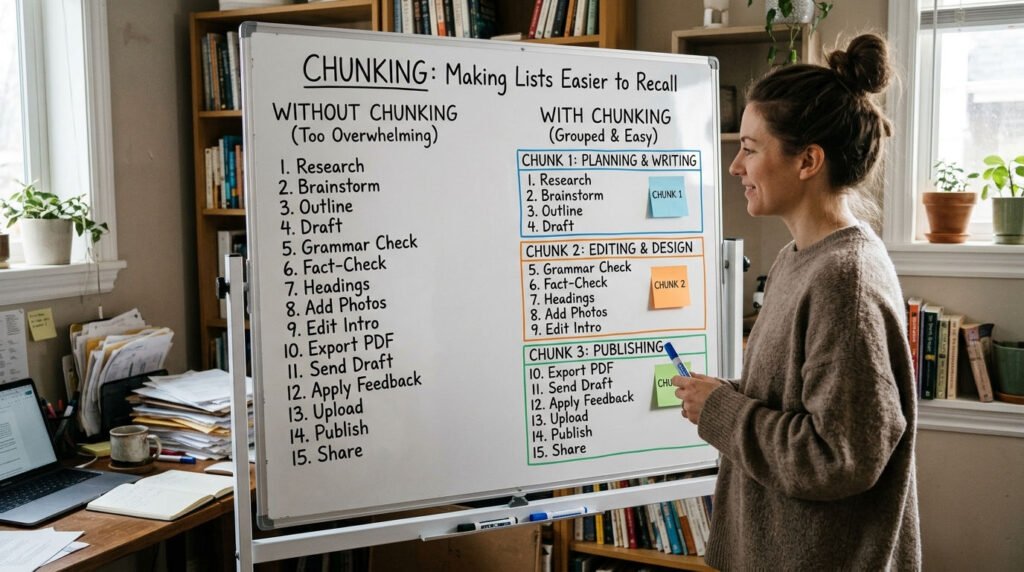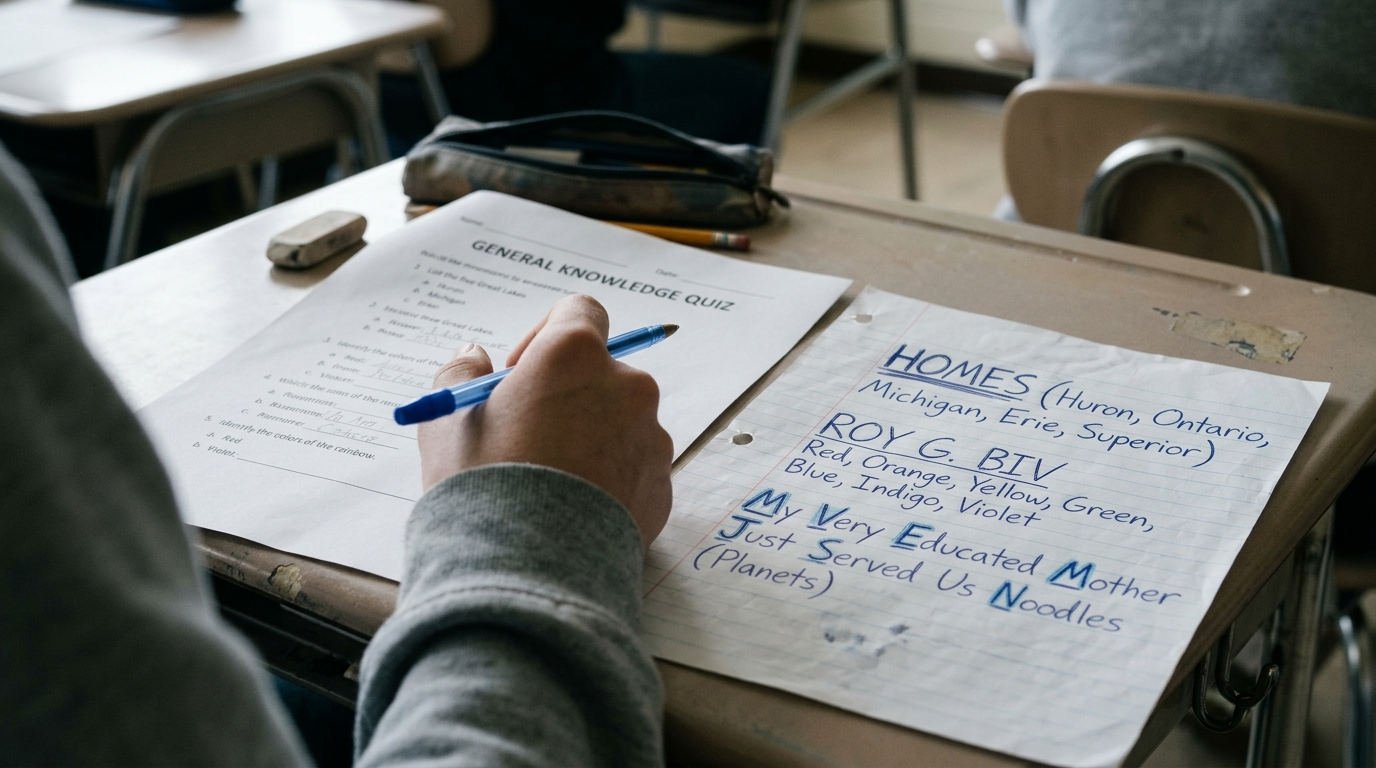
A mnemonic can make information easier to retrieve by giving it a memorable cue. It works best when the cue points back to material you already understand.
Choose information suited to a cue
Short lists, ordered steps, and groups of terms are good candidates. Complex reasoning usually needs explanation and practice, not only a catchy phrase.
A mnemonic works well for a sequence of names or stages when the learner already understands what those names represent. It is less useful for an explanation that requires causes and relationships. Before inventing a cue, list the exact items to recall, check their order, and ask whether a short code would actually reduce confusion. Do not hide an incomplete understanding behind a memorable phrase.
Build an acronym from initials
Take the first letters of a set of items and arrange them into a memorable sequence when possible. Check that every initial maps to the right term and order.
For a list whose initials form a pronounceable abbreviation, turn those letters into a cue and check every expansion against the source. If the list contains similar initials, add a distinguishing keyword. The goal is to retrieve the actual terms, not merely the string of letters. After making an acronym, write the original list from memory without looking at the completed example.
Make an acrostic sentence
A sentence whose word initials match a list can be more memorable than a string of letters. Use a sentence that is natural or amusing to you, without obscuring the original information.
An acrostic sentence assigns one word to each item in an ordered list. A student might use a whimsical sentence because unusual imagery is memorable, but the words must still match the target initials in the correct order. If the sentence is so elaborate that you remember the joke but not the lesson, simplify it. A reliable cue should point back to knowledge with minimal decoding effort.
Use sound and rhythm carefully
Rhymes may support recall of names or patterns, but a rhyme cannot prove a scientific relationship. Test the remembered fact against accurate notes.
A rhythm or rhyme can help with an ordered list, especially when repeated calmly. It may also create a misleading sense of mastery: reciting a rhyme is not the same as explaining what each term means. After saying the cue, pause and expand every item in plain language. Test whether you can recover the information without the original sound pattern present.
Attach an image to a cue
A vivid mental scene can distinguish similar facts. For example, imagine a thermometer beside an ice cube to recall a temperature-related distinction.
If you are memorizing three layers of the Earth, imagine a cutaway globe where each layer is associated with a distinct colour or physical texture. The picture can prompt retrieval, but it must not introduce incorrect scientific details. Explain the relationship between layers separately. An image serves as a doorway to the fact, not as an alternative account of the subject.
Avoid cues that confuse the answer
If two terms start with the same letter, initials alone may be ambiguous. Add a second cue, defining feature, or context to keep them separate.
Two biological terms may share the same initial. A mnemonic using only that initial could cause a swap at quiz time. Add an extra cue based on meaning, sequence, or another letter. The strongest memory device is specific enough to retrieve one intended answer rather than a group of vaguely similar possibilities. Test it against the kind of distinction your quiz actually asks you to make.
Retrieve the material, not just the mnemonic
Recite the cue and then explain every item without reading. If you remember the phrase but cannot expand it accurately, the device needs adjustment.
In practice, recite the mnemonic and then write the full ordered information without notes. If you remember only the first and final items, the cue is incomplete. Rebuild the weak middle connection and test it after a delay. Avoid scoring yourself as correct just because you can repeat the sentence fluently; the assessed knowledge is what the sentence is meant to recover.
Retire or revise weak cues
After practice, keep aids that genuinely support accurate recall and replace those that produce swapped order or missing facts. The method is a tool, not a required ritual.
A cue that worked for the first two sessions may become confusing when more material is added. Keep a short list of what it successfully retrieves and where errors occur. If a mnemonic overlaps with another one, redesign the image or phrasing so the two are distinct. Revision tools should be evaluated by accurate recall in new questions, not by how clever they sound when first created.
Try it: design and test a memorable cue
Create a short phrase to remember the order of four stages in a topic you already understand.
Decode it back into the accurate terms and explain what each stage means without relying on the phrase.
Check whether a changed list would make the cue misleading and rewrite it if necessary.