Visual memory techniques can provide extra cues for information that otherwise feels abstract. They work best when an image is accurate enough to bring the right fact back.
Turn a fact into a concrete scene
A vivid picture of an object or action may be easier to recall than isolated symbols. Connect the scene directly to the fact you need.
An abstract fact becomes easier to cue when you turn it into a distinct scene. To remember that condensation forms droplets on a cold surface, imagine a glass slowly collecting beads of water. The visual should represent the real process accurately. If it instead suggests water appearing from nowhere, the image might become memorable for the wrong reason. Meaning still governs the cue.
Give dates a consistent visual code
Associate a number with an image you can recognize, but verify the date from notes. A memorable image that points to the wrong year is worse than no aid.
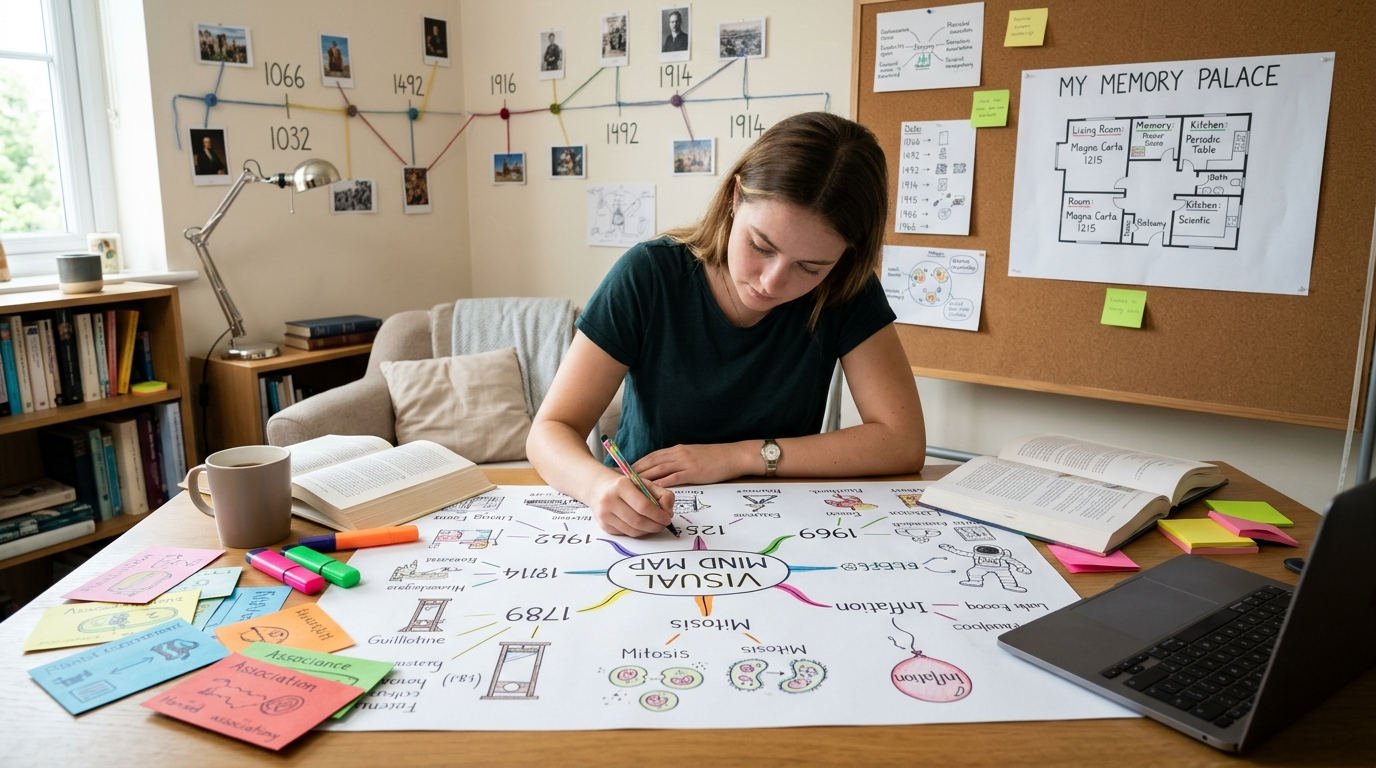
Dates are particularly prone to confusion when several events occur in one century. You can associate a year with an image or location, but first verify the year and event from an accurate source. Do not assume the remembered image proves the fact. Practise moving from the cue to the full statement, including what happened and why the date matters in the lesson.
Use spatial position deliberately
Place related terms in fixed locations on a page or diagram. Retrieving the position can lead you back to the relationship between concepts.
Placing three related concepts at fixed points on a page can provide a useful retrieval path: first the definition, then an example, then an exception. Spatial organization is helpful only when the positions stay consistent during review. Keep the meaning of each location clear. If you rely solely on where a word sat in one handout, a differently formatted test may leave you without enough knowledge to answer.
Draw diagrams for connected ideas
A labelled cycle or process map may reveal relationships better than a decorative photograph. Keep labels accurate and the direction of arrows meaningful.
A labelled diagram of the water cycle can show evaporation, condensation, and precipitation with directional arrows. Its value is not just colour; the arrows express relationships and sequence. Cover the labels and reconstruct the process, checking that each movement is scientifically accurate. For complex topics, a precise visual model can be more informative than a dramatic but unrelated imagined picture.
Make confusing images more distinct
If two concepts produce similar scenes, add a feature that represents their difference. The distinguishing detail should be conceptually relevant.
Two memory images that both involve a cloud may blur together. Add a distinguishing feature that reflects the underlying concept, such as rising vapour for evaporation and forming droplets for condensation. Avoid adding random details that compete with the actual cue. The image should help you choose between terms when the quiz describes one process without naming it.
Combine sight with explanation
After looking at an image, cover it and state what each part means. Visual familiarity is not a replacement for accurate description.
After studying an image, turn it over and explain each element in words. For a historical timeline, say what each picture stands for, when the event occurred, and how it relates to its neighbours. If you remember the colour but not the fact, revise the association. Visual techniques support retrieval; they do not prove that the information behind the picture is correct or complete.
Avoid overloading a single picture
Too many unrelated facts attached to one scene make it harder to retrieve the target. Create separate images or groups when the association becomes crowded.
A crowded scene containing ten dates, eight formulas, and several unrelated terms may become difficult to decode. Divide information into smaller visual groups or choose a different memory method for some material. Keep the strongest associations and remove decorative clutter. The goal is a small number of cues that reliably lead to answers, not a collection of pictures impressive enough to display.
Test whether the picture transfers
Answer a fresh question without viewing the cue. If you can retrieve the fact in a different context, the technique is helping rather than merely decorating your notes.
Test a visual association with a question that does not show the picture. If you can answer a short explanation prompt after a delay, the technique may be helping recall. If you can redraw the image but cannot explain the term, go back to understanding the underlying fact. A cue should remain useful when the assessment changes the format or asks for reasoning.
Try it: test a visual association later
Match three historical dates to vivid but distinct visual images and tell a short story that places them in order.
Verify every date against your notes and make sure the image retrieves the correct event, not merely a familiar scene.
Test the associations two days later without looking at the images first.