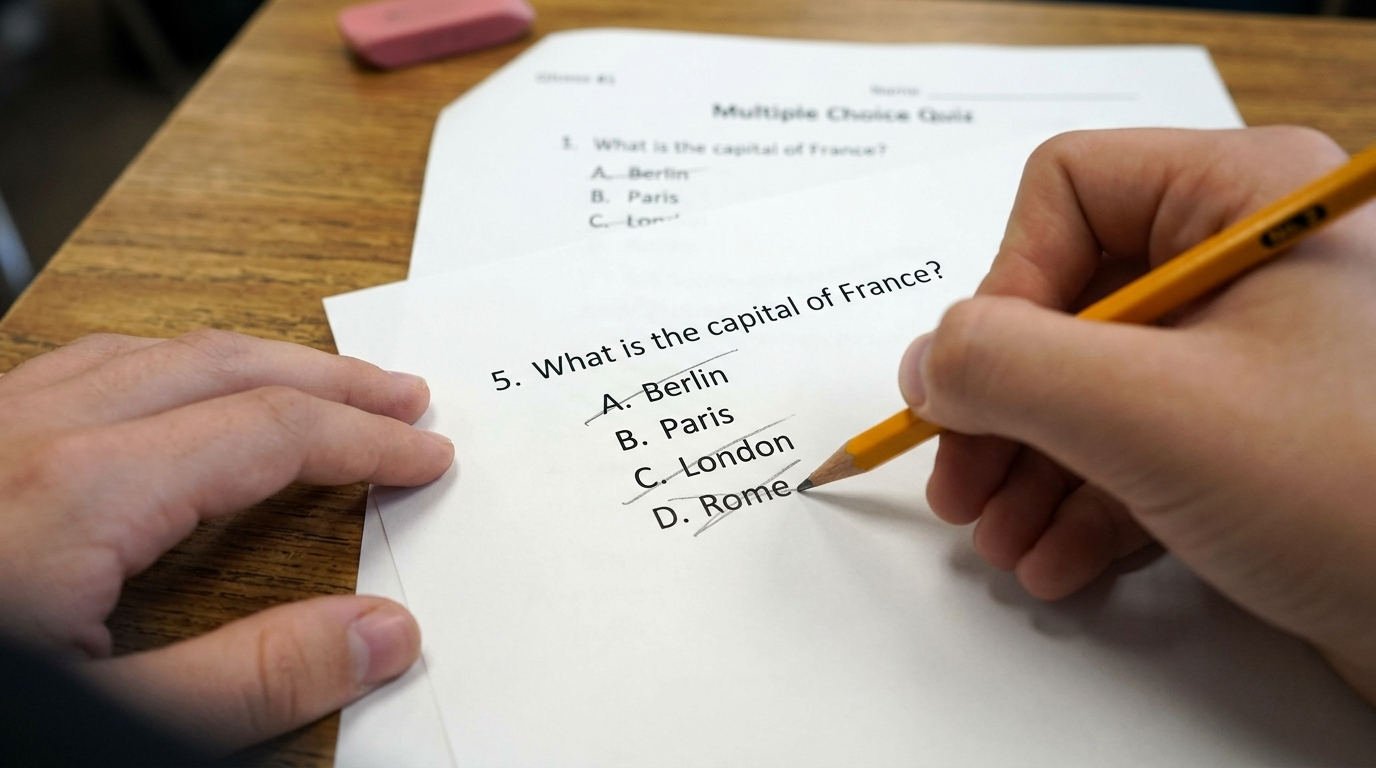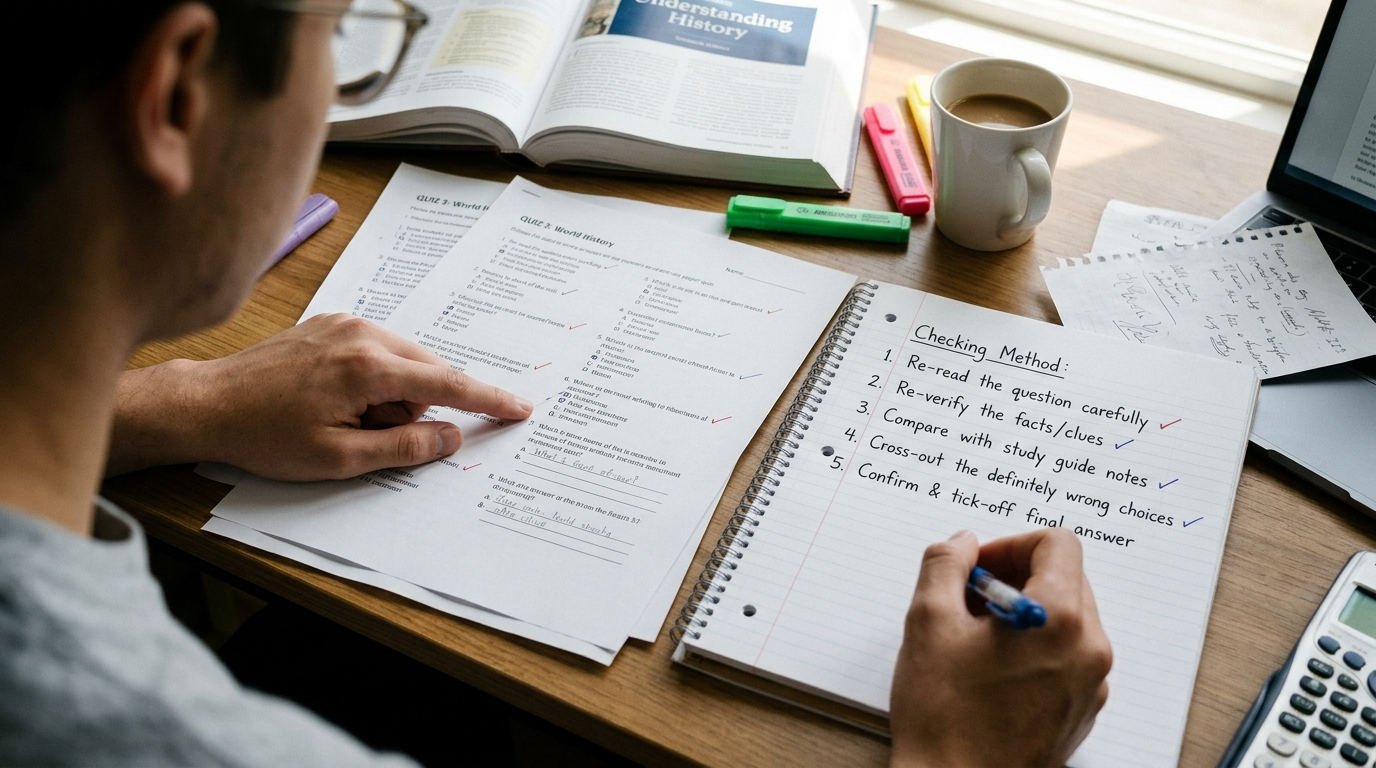
A final answer check should be targeted, not a nervous attempt to redo the entire quiz. A short sequence of reliable checks can catch mistakes while leaving sound answers intact.
Confirm that every item has a response
Scan the numbering from start to finish. On paper, check that each response aligns with the intended question; online, review any unanswered-item indicator before submitting.
Start with an answer count, especially after using the skip-and-return method. If the last item is question 25, confirm you have responses for 1 through 25. On a digital quiz, a summary panel may show unanswered items; on paper, scan numbers and spaces. This is a mechanical check, but its impact can be larger than polishing an already-correct explanation.
Revisit marked uncertainty first
Questions you flagged during the first pass deserve attention before answers supported by clear evidence. Check whether the uncertainty came from knowledge, wording, or a rushed calculation.
Not every uncertain answer deserves equal time on review. Marked items where you narrowed the choice to two may be resolvable with one extra fact. A topic you have no knowledge of may not improve through repeated staring. Decide which issue is answerable with the information and minutes you have, then direct attention there first.
Read negative instructions again
“Not,” “except,” and “least likely” can reverse an otherwise sensible choice. A second reading is especially valuable when several prompts use similar vocabulary.
Consider a prompt asking which statement is “least accurate.” You might correctly recognize three statements but select the most accurate one if you overlook “least.” During final review, read the sentence with its negative or superlative explicitly attached. This check is particularly valuable when a quiz switches between positive and negative instructions without warning.
Check calculations by a different route
Estimate an answer's size, inspect units, and substitute the result back when possible. Repeating exactly the same arithmetic may reproduce the original error.
If an arithmetic result is 8,400 metres for a short classroom measurement, estimate its scale before accepting it. Check decimal placement, conversion factors, and whether you divided or multiplied. In geometry, substitute a found value into the original relation. A second method does not need to reproduce all your steps; it needs to test whether the result behaves sensibly.
Make sure short answers meet the command
A definition is not an explanation and an example is not always a comparison. Verify that your response includes the kind of detail the mark scheme is likely to reward.
A history short-answer prompt asking “give a reason” cannot be fully satisfied by naming only a year. Likewise, a comparison needs both sides. Read your own response as if it were written by someone else and ask whether every part of the command has been answered. If space remains, add only the missing supporting detail, not an unrelated paragraph.
Investigate, do not merely doubt, a choice
Change an answer only when you discover a specific contradiction, overlooked condition, or better-supported alternative. Vague second thoughts are not reliable evidence.
Changing an answer because the previous three options were “B” is not a correction; the letters are not evidence. Changing it because you remembered that an option contradicts a definition is a real revision. During review, ask what new information justified the change. This habit protects reliable first answers while still leaving room to catch authentic mistakes.
Review the answer-transfer step
If a bubble sheet or separate response form is used, check that entries have not shifted by one row. This procedural mistake can affect several otherwise correct answers.
When filling a separate answer sheet, check alignment after every skipped question. A learner who left number seven blank may accidentally mark answer eight on line seven and shift subsequent answers. Verify a few question numbers and their corresponding responses at intervals, especially near flags. This is a procedural check with a clear and preventable failure mode.
Build a personal review checklist
After each practice quiz, record the errors you actually make. A student who frequently drops negative signs needs a different final check from one who often misses key words.
Create a tiny final-pass list based on your last few quizzes: “read negations,” “check units,” “review flagged items,” or “match numbers.” Do not add every possible mistake ever made. A short list can be applied under pressure; a long generic list is easier to ignore. Replace items as your error pattern changes so the review time stays useful.
Try it: check an answer in three passes
Answer a ten-question practice set and spend your review on the answer sheet rather than re-solving everything.
Match every selected option to the intended question number, then inspect negatives, units, and unfilled boxes.
Record whether the checking step caught a transfer error, a knowledge error, or no error at all.