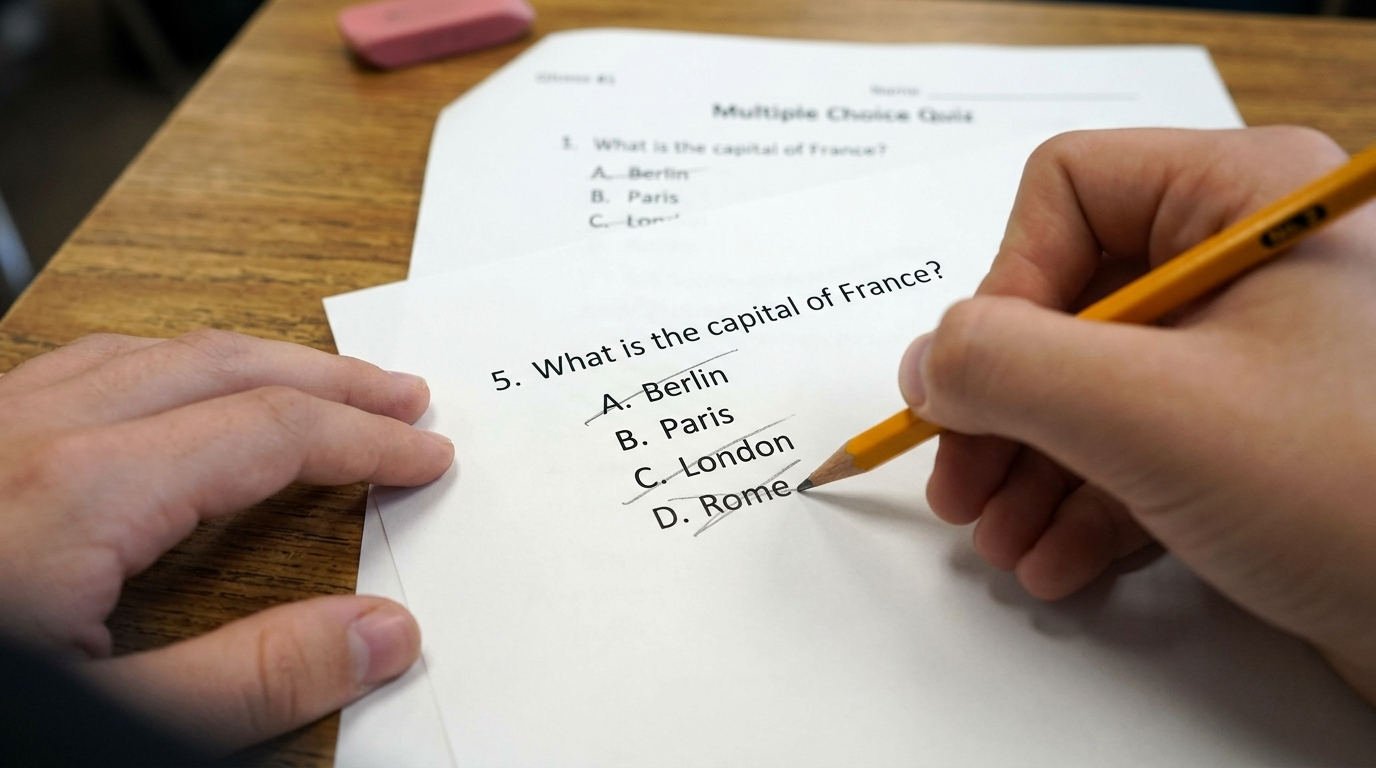
Useful question clues are rarely secret tricks. They are ordinary words, units, comparisons, and conditions that signal how an accurate answer should be constructed.
Notice instructions hidden in verbs
“Explain” requires reasoning, “calculate” requires working, and “choose” requires selection. When a prompt says “justify,” a bare number may be insufficient even if the number is correct.
Command words can be tested by rewriting one familiar prompt. “List three causes of pollution” asks for examples; “explain two causes” asks for mechanisms; “evaluate a response” asks for a judgment supported by criteria. The topic remains the same, but the answer structure changes. Read the verb as an instruction to your thinking, not just the first word of a sentence.
Treat qualifiers as part of the fact
“Most effective under cold conditions” is not the same claim as “most effective.” Underline time periods, locations, age groups, or experimental conditions that restrict the statement.
A prompt that asks what happens “in the first ten minutes” should not be answered with a trend from the entire experiment. The time phrase defines the relevant evidence. In history, the same issue appears with “before the reform” or “after the treaty.” Highlight the stated boundary, then ignore facts that belong outside it even if they are true and memorable.
Compare the question with the available units
If a problem asks for speed in kilometres per hour, choices in metres or total distance signal a mismatch. Units can help you identify the necessary calculation before you compute anything.
Imagine a bar-chart question asking for the difference in rainfall measured in millimetres. An answer expressed only as the highest month does not address the comparison, while an answer in centimetres may require conversion. Check both the operation and unit. When several numbers look plausible, unit consistency can help distinguish a properly reasoned solution from a distractor.
Spot contrast and exception language
Words such as “however,” “except,” “unlike,” and “whereas” may change which detail matters. In reading passages, the sentence after a contrast often modifies an earlier claim.
“Which statement is supported except ...” signals that one option should fail while the others fit. In an argument passage, “however” may introduce a qualification to a previous claim. Track who is speaking, what is being contrasted, and whether the exception is explicit. A clue helps only when read within the surrounding sentence; isolated trigger words can mislead.
Use paired options as information
Two alternatives that share most words may point to a precise distinction the question is testing. Inspect their difference, then verify against the source material rather than assuming one must be correct.
If two multiple-choice statements differ only in “causes” versus “is associated with,” they may test whether the evidence demonstrates causation or merely a relationship. A graph showing two variables moving together does not automatically establish a mechanism. Inspect what the prompt says was measured and whether any controlled experiment is described before accepting a causal claim.
Look for cause-versus-result confusion
A statement about what happens after an event does not necessarily explain why it happened. Ask whether the prompt wants a mechanism, outcome, evidence, or sequence.
A quiz about a plant wilting may ask for the result of limited water, not the reason water was unavailable. Those questions touch the same event but require different links in a chain. Sketch a quick cause → process → outcome sequence when the distinction is unclear. Then locate which link the command word requests and answer only that part.
Avoid unreliable test-taking myths
The longest answer is not necessarily correct; neither is the option with the most technical vocabulary. Treat these features as presentation, not proof, unless the question supplies real supporting evidence.
Some students are taught to prefer long or detailed options, but there is no sound general rule that length determines correctness. A long answer can include an extra false clause, while a short one can be complete. Test each candidate against evidence and instructions. If you cannot state a valid reason, treat the answer as uncertain regardless of its apparent sophistication.
Train your eye on altered examples
Take a correct practice question and replace “increases” with “decreases” or change a measurement. Observe how the required reasoning changes; this teaches close reading without relying on tricks.
Write two versions of a science question, one asking what increases as temperature rises and another asking what decreases. Keep the same four plausible options and notice how one changed verb affects the result. Also practise adding “only” or “most likely” to a statement. This trains attention to evidence-bearing words rather than a checklist of alleged test-maker secrets.
Try it: underline a qualifier that matters
Invent two nearly identical geography questions, one asking for the highest value and the other for the lowest.
Circle the comparison word and the measurement unit before reading the answer options.
Add the word “approximately” to one question and discuss how that changes the expected precision.